Why Blade Runner 2099 Could Revive Cyberpunk Storytelling
Why Blade Runner 2099 Could Revive Cyberpunk Storytelling – Cyberpunk has always been more than a visual style. Neon-lit streets, towering megacities, flying vehicles, artificial humans, and rain-soaked alleyways may define its aesthetic, but the genre has survived because it asks uncomfortable questions about technology, identity, inequality, and the future of humanity. Few franchises have explored those questions as deeply as Blade Runner. With Blade Runner 2099, the world created by Ridley Scott and expanded through decades of science fiction storytelling has an opportunity to bring cyberpunk back into the cultural spotlight.
The appeal of Blade Runner 2099 lies not simply in returning to a familiar fictional universe. The series could demonstrate how cyberpunk storytelling can evolve for a generation living with artificial intelligence, automation, digital surveillance, synthetic media, and increasingly blurred boundaries between humans and machines. Rather than repeating the themes of earlier installments, a new chapter set in 2099 could explore what happens when technologies once considered futuristic become ordinary parts of everyday life.
The Enduring Legacy of Blade Runner
The original Blade Runner, released in 1982, established a vision of the future that influenced science fiction for decades. Based loosely on Philip K. Dick’s novel Do Androids Dream of Electric Sheep?, the film presented a dystopian Los Angeles filled with corporate power, advanced artificial beings, environmental decay, and social inequality.
Its most important contribution was the way it treated technology. Machines were not simply tools or enemies. They were part of a complicated society where the definition of humanity itself became uncertain.
Blade Runner 2049 continued that tradition while introducing a slower, more introspective approach to the franchise. The film expanded the universe and explored questions surrounding memory, identity, artificial reproduction, and social hierarchy.
Blade Runner 2099 has the opportunity to take those ideas even further.
The year 2099 creates significant creative freedom. The story can move beyond the familiar visual language of the 1982 film and its sequel while maintaining the philosophical foundation that made the franchise important.
Cyberpunk Is More Relevant Than Ever
Cyberpunk traditionally imagines a future where advanced technology exists alongside social problems. Powerful corporations control enormous resources, governments struggle to maintain authority, and ordinary people live under increasingly sophisticated systems of surveillance and automation.
Those ideas no longer feel purely fictional.
Artificial intelligence is becoming part of workplaces, entertainment, education, software development, healthcare, and communication. Facial recognition and algorithmic monitoring are increasingly common. Automation is changing employment patterns, while digital platforms influence how people consume information and interact with one another.
These developments create exactly the kind of tension cyberpunk storytelling has historically explored.
The difference is that today’s audiences have firsthand experience with many technologies that once seemed impossible. A futuristic story therefore needs more than holograms and flying cars to feel innovative. It needs to examine how technology changes human behavior and society.
This is where Blade Runner 2099 could become especially powerful.
Instead of asking whether artificial intelligence will eventually exist, the story could ask what society looks like after generations of living alongside intelligent machines.
A Future Where AI Is Ordinary
One of the most interesting possibilities for Blade Runner 2099 is a world where artificial intelligence is no longer considered revolutionary.
In earlier cyberpunk stories, artificial beings were often treated as technological breakthroughs. By 2099, however, intelligent synthetic entities could be integrated into nearly every aspect of society.
They might work as employees, caregivers, researchers, artists, law enforcement officers, politicians, or companions. Some could possess physical bodies, while others might exist primarily in digital environments.
That creates a more complicated question than whether machines are conscious.
The question becomes whether society cares if they are conscious.
A future society might depend heavily on artificial intelligence while still denying intelligent machines political rights. Companies could create synthetic workers specifically designed to perform dangerous or undesirable jobs. Wealthy individuals might purchase highly advanced artificial companions, while less privileged communities could rely on outdated systems.
This would allow Blade Runner 2099 to explore inequality through the relationship between humans and artificial beings.
The central conflict could therefore become less about humans versus machines and more about different groups competing over who gets to control intelligence itself.
Corporate Power Could Become the New Villain
Corporate dominance has always been central to cyberpunk. In the Blade Runner universe, powerful companies have played a major role in creating and controlling artificial life.
By 2099, corporate influence could become even more sophisticated.
Companies might control entire cities, energy networks, transportation systems, digital identities, and artificial intelligence platforms. Citizens could depend on private corporations for services that were once managed primarily by governments.
This creates fertile ground for storytelling.
Imagine a city where every resident has a digital identity connected to an artificial intelligence system. The system manages healthcare, transportation, employment, security, and financial transactions. On the surface, the city appears efficient and safe.
But what happens when the system decides that certain people are statistically dangerous?
What happens when an algorithm determines who receives medical treatment, housing, or employment?
And what happens when someone discovers that the system has been secretly manipulating human memories?
These questions fit naturally within the Blade Runner universe because the franchise has always been interested in the relationship between technological power and individual freedom.
The Meaning of Being Human Could Change Again
The most important theme in Blade Runner has always been humanity.
Replicants forced audiences to question whether biological origin determines human worth. Their emotions, memories, fears, and desires made the distinction between human and artificial increasingly difficult to maintain.
A story set in 2099 could make that distinction even more complicated.
Future technology could potentially allow humans to replace damaged organs, enhance their senses, alter their memories, or connect their minds directly to digital systems. Meanwhile, artificial beings could become increasingly indistinguishable from humans.
Eventually, the question might no longer be whether an artificial being can become human.
Instead, the question could be whether humans themselves are becoming something else.
If a person replaces most of their biological body with artificial components, preserves their memories digitally, and uses artificial intelligence to enhance their thinking, where does humanity end?
That philosophical uncertainty could give Blade Runner 2099 the same emotional depth that defined the original franchise.
A New Generation of Cyberpunk Characters
Another way the series could revive cyberpunk storytelling is by introducing characters who reflect modern concerns.
Earlier protagonists often existed on the margins of society. A new generation could include investigators, synthetic workers, corporate employees, hackers, activists, artificial intelligence developers, and ordinary citizens trying to survive in an increasingly automated world.
The protagonist does not necessarily need to be a traditional detective.
A character working inside a massive technology corporation could discover that the company is manipulating artificial memories. Another character could be an artificial intelligence investigator searching for other synthetic beings who have disappeared. A third could be a human whose memories have been altered so many times that they no longer know which experiences actually belong to them.
These characters could create a more diverse cyberpunk narrative while maintaining the mystery and philosophical atmosphere associated with Blade Runner.
Cyberpunk Beyond Neon and Rain
The visual identity of Blade Runner is iconic, but there is a danger in relying too heavily on its familiar aesthetic.
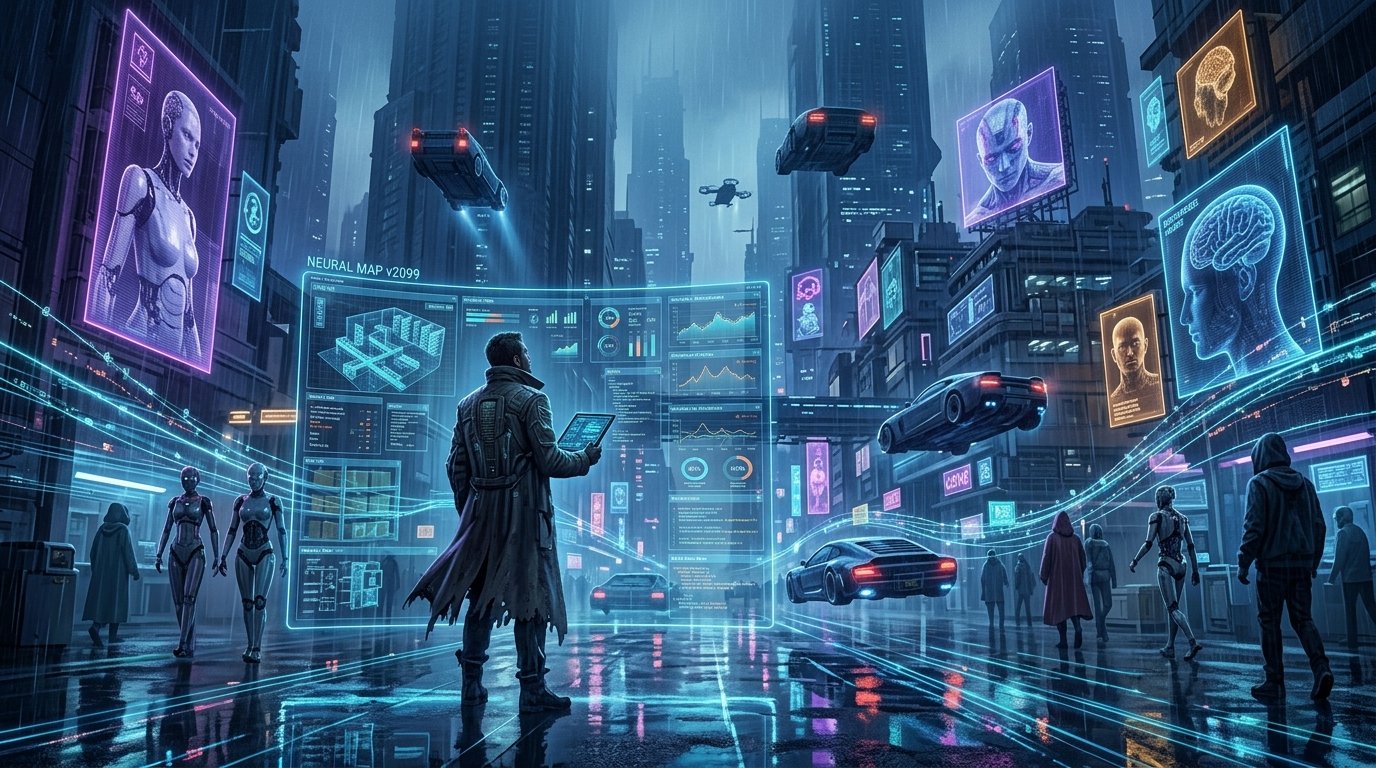
Neon signs, dark streets, holographic advertisements, and constant rain have become shorthand for cyberpunk. Countless films, games, and television series have adopted similar imagery.
For Blade Runner 2099 to feel genuinely fresh, its world should demonstrate how cyberpunk environments have evolved.
A city in 2099 might not always be dark and polluted. Wealthy districts could be perfectly clean, climate-controlled, and almost unnaturally beautiful. Advanced technology could create artificial weather, vertical forests, automated architecture, and cities that constantly redesign themselves.
Meanwhile, neglected communities could exist beneath these futuristic spaces.
That contrast would create a new visual language for cyberpunk. Instead of presenting the future as universally dystopian, the series could show a world divided between different versions of reality.
The rich might experience a technological paradise.
Everyone else might experience the consequences of maintaining it.
The Importance of Memory
Memory is another theme that could become increasingly relevant in a 2099 setting.
In the Blade Runner universe, memories are deeply connected to identity. If artificial beings can receive implanted memories, then personal history becomes something that can potentially be manufactured.
Future technology could take this idea much further.
Imagine a world where people can back up memories, delete traumatic experiences, purchase artificial childhood memories, or transfer memories between bodies.
Such technology could have enormous consequences.
A wealthy person might preserve memories for centuries by transferring them between biological or synthetic bodies. A criminal might erase evidence from their own mind. Governments could manipulate memories to influence political behavior. Corporations might sell personalized memories as entertainment.
In such a world, remembering something would no longer guarantee that it actually happened.
That creates an ideal environment for mystery and psychological storytelling.
Social Inequality in a Technological Future
Cyberpunk has always been associated with the phrase “high tech, low life.” The contrast between advanced technology and social inequality remains one of the genre’s strongest ideas.
By 2099, technology could make inequality even more extreme.
Imagine a society where wealthy citizens have access to life-extension technologies, advanced synthetic organs, private artificial intelligence, and customized environments. Meanwhile, poorer communities depend on inexpensive machines that are unreliable, outdated, or controlled by corporations.
Technology would not necessarily eliminate inequality.
It could amplify it.
This could allow Blade Runner 2099 to explore economic themes without turning the story into a simple political lecture. Characters could experience inequality through everyday situations involving housing, employment, healthcare, transportation, and access to information.
The future would feel believable because its technological progress would not automatically solve human problems.
Why Television Could Be the Right Format
The episodic structure of television also gives Blade Runner 2099 an advantage.
The original Blade Runner and Blade Runner 2049 had to tell their stories within the limitations of feature-film runtime. A television series can spend more time exploring different characters, neighborhoods, social groups, and philosophical questions.
One episode could focus on an investigation involving artificial memories. Another could explore the lives of synthetic workers. Another could examine corporate politics. A later episode could reveal how these apparently separate stories connect.
This structure could make the world feel much larger.
Instead of simply watching a protagonist move through a futuristic city, viewers could understand how different people experience the same world in completely different ways.
That depth is particularly important for cyberpunk because the genre works best when the setting feels like a living society rather than a decorative backdrop.
Reviving the Philosophical Side of Science Fiction
Modern science fiction frequently emphasizes spectacle. Large-scale visual effects, futuristic technology, and action sequences can create impressive entertainment, but cyberpunk has traditionally offered something different.
Its greatest strength is its ability to make audiences question themselves.
Blade Runner 2099 could revive that philosophical tradition by focusing on questions that do not have easy answers.
Can a machine have a soul?
Can a human memory be trusted?
Does consciousness require a biological brain?
Should artificial intelligence have legal rights?
If technology can extend human life indefinitely, what gives life meaning?
If corporations control the systems that define reality, can individuals truly be free?
These questions could make the series relevant far beyond science fiction fans.
The Future of Cyberpunk Storytelling
Cyberpunk has never really disappeared. Video games, anime, films, novels, and television series continue to use its ideas. However, the genre has reached a point where simply reproducing the aesthetics of earlier works is no longer enough.
The future of cyberpunk must reflect the technological anxieties of the present.
Artificial intelligence, automation, digital identity, synthetic media, surveillance, biotechnology, climate change, and corporate power provide an enormous collection of modern issues for storytellers to explore.
Blade Runner 2099 has the opportunity to bring these issues together inside one of science fiction’s most recognizable universes.
Its greatest achievement would not be creating the most spectacular futuristic city or the most advanced artificial human.
It would be making audiences question what they believe about technology, identity, and humanity.
Conclusion
Blade Runner 2099 could revive cyberpunk storytelling by taking the genre’s classic questions into territory that feels relevant to the twenty-first century. The franchise already has a powerful foundation built around artificial intelligence, memory, corporate power, inequality, and the meaning of humanity.
The challenge is to avoid simply repeating what came before.
A successful new chapter should imagine what happens when the technologies that once seemed futuristic become completely ordinary. It should explore a society where humans and artificial intelligence coexist, where memories can be manipulated, where corporations can influence entire cities, and where technological progress does not necessarily produce a better world.
Most importantly, Blade Runner 2099 could remind audiences that cyberpunk is not really about neon lights or futuristic machines. It is about people trying to remain human inside systems that are becoming increasingly powerful and difficult to understand.
That idea is more relevant than ever.
If the series embraces that philosophy while creating new characters, new conflicts, and a genuinely evolved vision of the future, Blade Runner 2099 could do more than continue a legendary franchise. It could help define the next generation of cyberpunk storytelling.