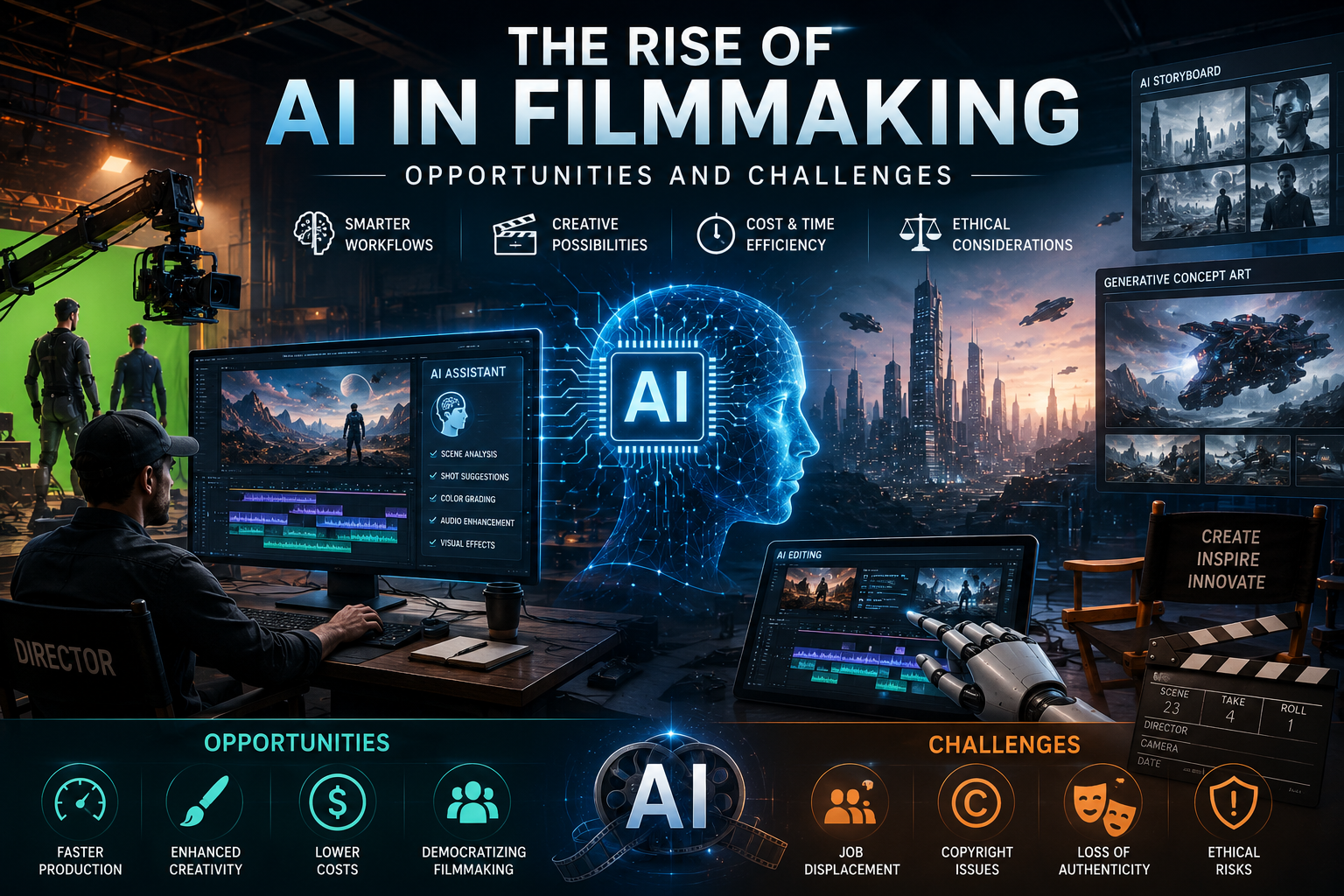
The Rise of AI in Filmmaking: Opportunities and Challenges
The Rise of AI in Filmmaking: Opportunities and Challenges – Artificial intelligence is rapidly transforming industries around the world, and filmmaking is no exception. Once considered a futuristic concept reserved for science-fiction stories, AI has become a practical tool used in movie production, visual effects, editing, marketing, and content development. From helping filmmakers create complex visual worlds to streamlining time-consuming production tasks, AI is reshaping how movies are made.
As Hollywood studios, independent creators, and streaming platforms increasingly embrace AI-powered tools, the debate surrounding the technology continues to grow. Supporters see AI as a revolutionary innovation that can democratize filmmaking and unlock new creative possibilities. Critics worry about its impact on jobs, artistic integrity, intellectual property, and the future of human creativity.
The rise of AI in filmmaking represents one of the most significant technological shifts in cinema since the introduction of digital cameras and computer-generated imagery (CGI). Understanding both the opportunities and challenges is essential for anyone interested in the future of entertainment.
How AI Is Entering the Filmmaking Process
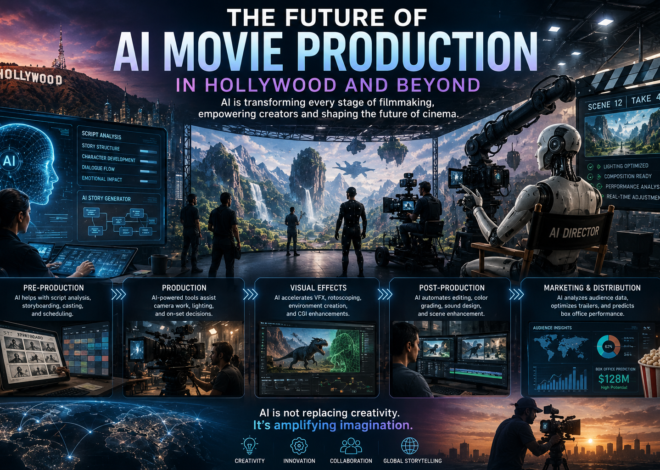
AI is now being used across nearly every stage of film production. Industry research shows that AI tools are increasingly supporting development, pre-production, physical production, and post-production workflows. These applications include storyboarding, script analysis, casting assistance, editing, visual effects, localization, and marketing.
In pre-production, AI can analyze scripts, identify potential production challenges, estimate budgets, and generate concept art. During production, machine-learning systems can assist with virtual environments, camera planning, and scene visualization. In post-production, AI helps editors organize footage, generate subtitles, synchronize audio, improve visual effects, and automate repetitive tasks.
Rather than replacing the entire filmmaking process, AI is currently functioning as a powerful assistant that enhances efficiency and expands creative options.
Opportunity 1: Faster and More Efficient Production
One of the most obvious advantages of AI is speed.
Traditional filmmaking often involves thousands of hours of manual work. Tasks such as organizing footage, creating rough edits, rotoscoping visual effects, and generating storyboards can consume enormous amounts of time and resources. AI-powered tools can perform many of these functions in minutes rather than days.
This efficiency allows filmmakers to spend more time on storytelling and creative decision-making. Production teams can test ideas more quickly, iterate on scenes, and reduce delays that might otherwise affect budgets and schedules.
For studios managing large-scale productions, AI has the potential to significantly lower costs while accelerating development timelines. Independent filmmakers can also benefit by gaining access to capabilities that previously required expensive teams or specialized software.
Opportunity 2: Enhanced Visual Effects and Virtual Production
Visual effects have become a central part of modern filmmaking, particularly in science fiction, fantasy, and superhero movies.
AI is helping artists generate complex environments, improve rendering workflows, remove unwanted objects, enhance image quality, and create realistic digital elements more efficiently. Modern AI systems can assist with character animation, facial tracking, background generation, and scene reconstruction.
The technology is also strengthening virtual production techniques. Filmmakers can build immersive digital worlds, experiment with lighting conditions, and preview scenes before filming begins. These capabilities reduce production risks and enable more ambitious creative projects.
As AI tools continue to improve, filmmakers may be able to create visually stunning cinematic experiences with significantly smaller budgets than in previous decades.
Opportunity 3: Democratizing Filmmaking
Historically, producing high-quality films required substantial financial resources, specialized equipment, and large production teams.
AI is helping lower these barriers.
New AI-powered creative tools allow independent filmmakers, content creators, and small studios to access advanced production capabilities once reserved for major Hollywood productions. Emerging technologies are making previsualization, visual effects, and content generation more accessible than ever before.
Many industry observers believe this shift could lead to greater diversity in storytelling. Creators from different backgrounds and regions may gain opportunities to produce compelling films without relying on massive budgets or traditional studio support.
Online discussions among filmmakers frequently highlight how AI-assisted workflows are enabling independent creators to experiment with ambitious cinematic projects that would have been financially impossible only a few years ago.
Opportunity 4: Supporting Creative Experimentation
Contrary to the belief that AI only automates work, many filmmakers view it as a creative collaborator.
Generative AI can help artists explore visual styles, create concept imagery, develop story ideas, and rapidly prototype scenes. Researchers studying AI and filmmaking suggest that these technologies may enable entirely new forms of artistic expression and aesthetic experimentation.
Directors can test multiple visual approaches before committing resources to production. Writers can explore alternative story structures. Production designers can generate and refine concepts more quickly.
In this sense, AI acts less as a replacement for creativity and more as a tool that expands the range of possibilities available to creators.
Challenge 1: Threats to Creative Jobs
Despite its benefits, AI has sparked significant concern throughout the entertainment industry.
Writers, actors, editors, visual-effects artists, and production professionals worry that automation could reduce employment opportunities. Industry analysts note that AI has the potential to affect numerous roles throughout the production pipeline.
These concerns have become a major topic of discussion in Hollywood. Labor organizations and creative professionals continue to advocate for safeguards that protect workers from unauthorized AI use and unfair replacement. Questions surrounding compensation, training data, and digital replicas remain highly controversial.
The challenge for the industry will be finding a balance between technological innovation and protecting the livelihoods of creative workers.
Challenge 2: Copyright and Intellectual Property Issues
One of the most complex legal questions surrounding AI involves intellectual property.
Many AI systems are trained using vast collections of existing content. This has raised concerns about whether copyrighted material is being used without proper permission or compensation. Studios, artists, and rights holders are increasingly focused on protecting their intellectual property as AI adoption expands.
Another issue involves digital likeness rights. Actors and performers want greater control over how their voices, appearances, and performances are replicated by AI technologies. Industry agreements are increasingly addressing these concerns through consent requirements and licensing frameworks.
Resolving these legal questions will play a crucial role in determining how AI develops within the film industry.
Challenge 3: Authenticity and Artistic Integrity
Some of the world’s most respected filmmakers remain skeptical about AI’s role in cinema.
Prominent directors have argued that filmmaking is fundamentally a human art form rooted in emotion, experience, and personal perspective. Critics worry that excessive reliance on AI could lead to generic storytelling, formulaic content, and a loss of artistic authenticity.
The concern is not necessarily that AI will create bad movies. Rather, it is whether audiences may lose the unique human qualities that make great films emotionally powerful and culturally meaningful.
Many filmmakers support using AI as a technical tool while rejecting the idea that algorithms should replace writers, directors, or performers.
Challenge 4: Ethical Risks and Deepfakes
AI-generated content also introduces ethical concerns.
Deepfake technology can create realistic synthetic performances, alter appearances, and generate convincing fake footage. While these capabilities may offer legitimate creative applications, they can also be misused in ways that raise serious ethical questions. Researchers have identified deepfakes and unauthorized digital manipulation as key challenges facing the future of AI-driven cinema.
Filmmakers, regulators, and industry organizations will need to establish clear standards that encourage innovation while preventing abuse.
The Future of AI in Filmmaking
The future of filmmaking is unlikely to be defined by humans versus machines. Instead, it will be shaped by collaboration between creative professionals and increasingly sophisticated technologies.
Evidence suggests that studios are continuing to invest heavily in AI tools while simultaneously developing policies to address concerns about labor, copyright, and artistic control. Industry adoption is accelerating even as debates over regulation and ethics continue.
Over the next decade, AI will likely become as common in filmmaking as digital editing software is today. The most successful creators may be those who learn how to combine technological innovation with uniquely human storytelling skills.
Conclusion
AI is transforming filmmaking at an extraordinary pace. It offers remarkable opportunities to improve efficiency, expand creative possibilities, reduce production costs, and make filmmaking more accessible to a wider range of creators. At the same time, it raises important questions about employment, copyright, artistic authenticity, and ethics.
The rise of AI in filmmaking is neither purely positive nor purely negative. Like every major technological innovation in cinema history, its impact will depend on how filmmakers, studios, regulators, and audiences choose to use it.
Ultimately, the future of film will not be determined by artificial intelligence alone. It will be shaped by the people who use these tools to tell meaningful stories, connect with audiences, and push the boundaries of cinematic imagination.