The Future of AI Movie Production in Hollywood and Beyond
The Future of AI Movie Production in Hollywood and Beyond – Artificial intelligence is no longer a futuristic concept confined to science-fiction films. It has become one of the most transformative technologies in the entertainment industry, changing how movies are planned, produced, edited, marketed, and distributed. While Hollywood has traditionally been the center of global filmmaking innovation, AI is expanding opportunities far beyond the major studios of Los Angeles. Independent creators, international production companies, streaming platforms, and even individual filmmakers are beginning to embrace AI-powered tools that promise to reshape the future of cinema.
As AI technologies continue to advance, the film industry faces a fascinating question: What will movie production look like in the next decade? The answer involves a blend of creativity, automation, efficiency, and ethical challenges that could redefine the art and business of filmmaking.
The Rise of AI in Movie Production
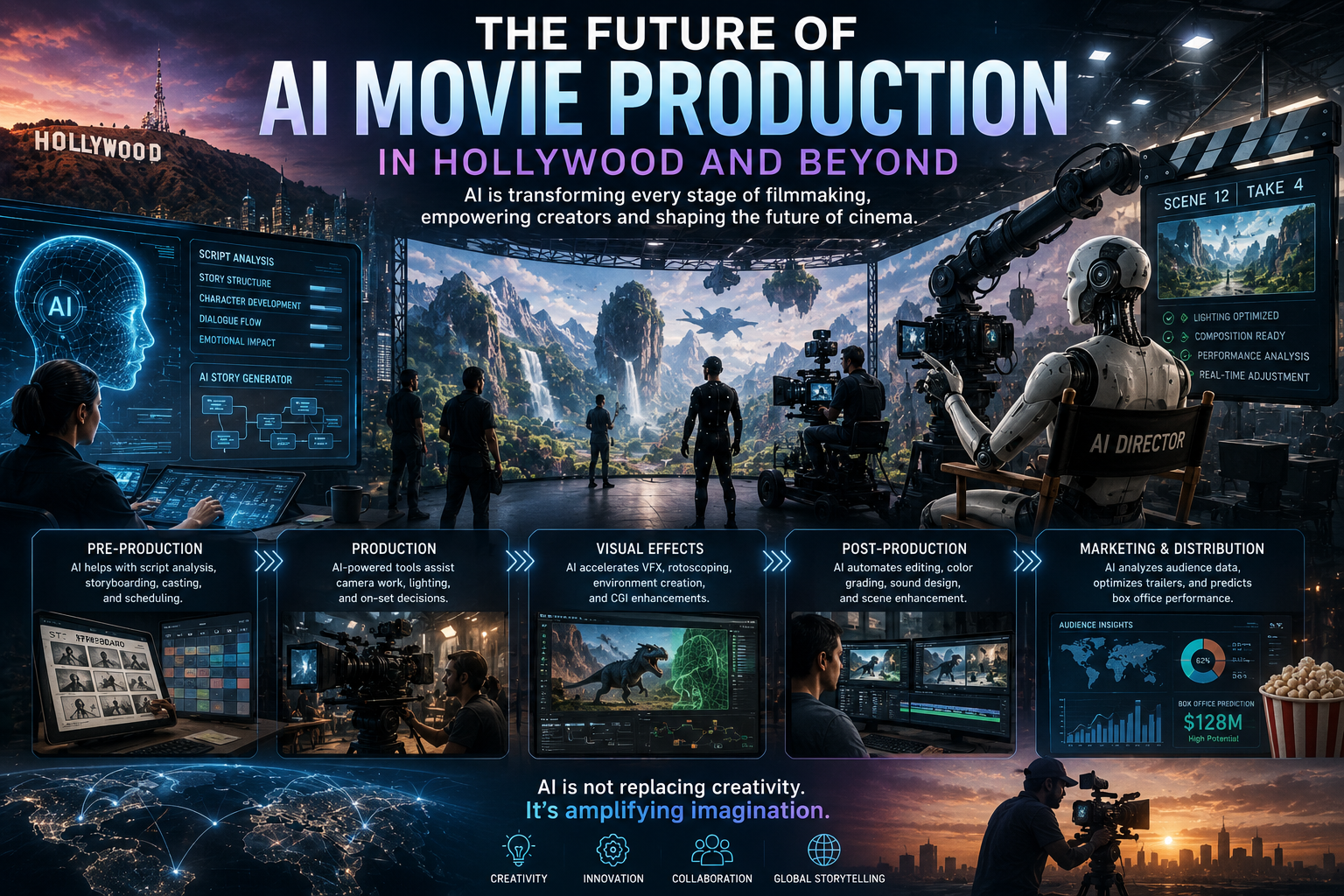
The use of artificial intelligence in filmmaking has grown rapidly over the past few years. What began as simple automation tools has evolved into sophisticated systems capable of assisting with script analysis, visual effects, editing, casting decisions, audience prediction, and virtual production.
Studios are increasingly adopting AI-powered software to streamline workflows and reduce production costs. At the same time, creators are discovering that AI can help generate ideas, visualize scenes, and automate repetitive tasks that once required large teams and significant budgets.
Rather than replacing human creativity, today’s AI tools primarily function as assistants that help filmmakers work faster and more efficiently. This collaborative approach is likely to define the next phase of AI movie production.
AI-Powered Script Development
One of the most interesting applications of AI is in script development.
Modern AI systems can analyze thousands of scripts and identify patterns related to successful storytelling. These tools can provide feedback on pacing, character development, dialogue structure, and narrative consistency.
Writers can use AI to brainstorm ideas, generate alternative plot directions, and explore creative possibilities. While AI cannot replicate human imagination and emotional depth, it can serve as a valuable partner during the early stages of development.
In the future, screenwriters may increasingly use AI as a creative assistant, helping them refine concepts and overcome writer’s block while maintaining control over the final story.
Revolutionizing Pre-Production
Pre-production is one of the most time-consuming phases of filmmaking. It involves storyboarding, concept art, scheduling, budgeting, location planning, and countless logistical decisions.
AI is making these processes faster and more efficient.
Generative AI tools can create concept artwork within minutes, allowing directors and production designers to visualize scenes before cameras start rolling. Virtual storyboards can be produced rapidly, helping creative teams experiment with different ideas and visual styles.
AI-driven planning software can also optimize shooting schedules, predict potential production challenges, and improve resource allocation. These capabilities help studios save time and money while reducing production risks.
Transforming Visual Effects
Visual effects have become essential to modern filmmaking, particularly in science fiction, fantasy, and action movies.
Traditionally, creating high-quality visual effects required enormous budgets and large teams of specialists. AI is beginning to change that equation.
Machine-learning tools can automate complex tasks such as object removal, motion tracking, facial animation, background generation, and image enhancement. Artists can use AI to accelerate workflows while maintaining creative control over the final result.
As AI technology improves, smaller studios and independent filmmakers will gain access to capabilities that were once available only to major Hollywood productions. This democratization of visual effects could lead to a new wave of ambitious and visually stunning films from around the world.
The Growth of Virtual Production
Virtual production has emerged as one of the most significant innovations in modern filmmaking.
Popularized by productions such as The Mandalorian, virtual production combines real-time rendering, LED walls, and digital environments to create immersive filming experiences. AI is enhancing these systems by generating environments, optimizing lighting conditions, and improving scene visualization.
Instead of traveling to multiple locations, filmmakers can create realistic digital worlds inside studios. This approach reduces costs, shortens production timelines, and offers greater creative flexibility.
In the coming years, AI-powered virtual production is expected to become a standard part of filmmaking across Hollywood and beyond.
AI-Assisted Editing and Post-Production
Editing is another area where AI is having a significant impact.
Modern editing software can automatically organize footage, identify the best takes, synchronize audio, generate subtitles, and perform preliminary cuts. Tasks that once consumed weeks can now be completed in a fraction of the time.
AI can also assist with color correction, sound enhancement, and visual cleanup. By automating repetitive technical work, editors can focus more on storytelling and creative decision-making.
The future of post-production will likely involve close collaboration between skilled editors and intelligent software systems, combining human judgment with machine efficiency.
Personalized Marketing and Audience Insights
Producing a great movie is only part of the challenge. Studios must also attract audiences.
AI is becoming a powerful tool for marketing and audience analysis. By examining viewer behavior, social media activity, and entertainment trends, AI can help studios understand what audiences want to watch.
Marketing teams can use AI to create targeted campaigns, optimize trailers, and predict audience reactions before a film is released. Streaming platforms already rely heavily on recommendation algorithms to connect viewers with content that matches their interests.
As data-driven decision-making becomes more sophisticated, AI will play an increasingly important role in how movies are promoted and distributed worldwide.
Opportunities for Independent Filmmakers
Perhaps the most exciting aspect of AI movie production is its potential to empower independent creators.
Historically, filmmaking required significant financial resources. Access to professional equipment, visual effects teams, and production infrastructure often limited opportunities for smaller creators.
AI is helping remove many of these barriers.
Affordable AI-powered tools allow filmmakers to generate concept art, create visual effects, improve audio quality, and streamline production workflows without massive budgets. This accessibility opens doors for storytellers from diverse backgrounds and regions.
As technology becomes more widely available, audiences may see a greater variety of voices and perspectives represented in cinema.
Challenges Facing AI Movie Production
Despite its many advantages, AI also presents serious challenges.
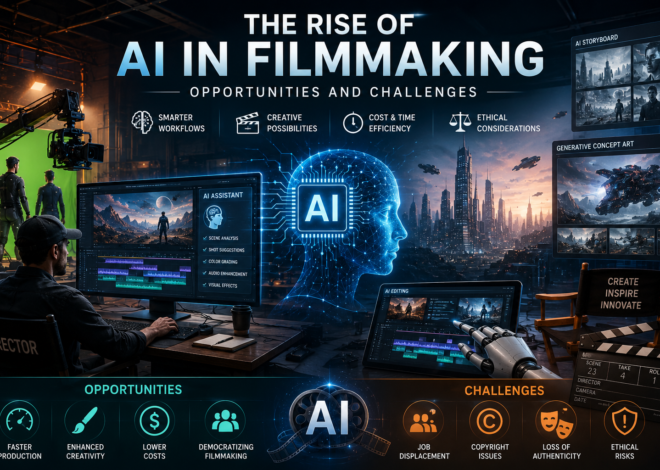
One of the biggest concerns involves employment. Writers, editors, visual-effects artists, and other creative professionals worry that automation could reduce job opportunities within the industry.
While AI is unlikely to replace human creativity entirely, it may alter the nature of many production roles. Workers will need to adapt by developing skills that complement emerging technologies.
The industry must find ways to embrace innovation while protecting creative careers and ensuring fair opportunities for professionals.
Copyright and Intellectual Property Concerns
Copyright issues remain one of the most debated topics surrounding AI.
Many generative AI systems are trained using large amounts of existing content. Questions about ownership, licensing, and compensation continue to generate legal and ethical discussions.
Actors are also concerned about digital replicas of their voices and appearances. Advances in AI make it possible to recreate performances with remarkable realism, raising important questions about consent and intellectual property rights.
Clear regulations and industry standards will be essential for ensuring responsible use of AI technologies in movie production.
The Human Creativity Factor
Despite rapid technological progress, filmmaking remains a deeply human art form.
Movies resonate because they reflect emotions, experiences, and perspectives that connect with audiences on a personal level. While AI can generate images, analyze data, and automate workflows, it does not possess genuine human experiences or emotional understanding.
Great films often emerge from unique artistic visions, cultural insights, and personal storytelling. These qualities remain difficult to replicate through algorithms alone.
The most successful filmmakers of the future will likely use AI as a tool rather than a replacement for creativity. Human imagination will continue to drive meaningful storytelling.
Beyond Hollywood: A Global Transformation
Although Hollywood remains a major center of innovation, AI movie production is becoming a global phenomenon.
Filmmakers in Asia, Europe, Latin America, Africa, and the Middle East are increasingly adopting AI technologies to enhance production capabilities and reach wider audiences.
International studios can use AI to create multilingual content, improve localization, and compete more effectively on the global stage. Streaming platforms have accelerated this trend by making international films more accessible than ever before.
As AI tools become more affordable and sophisticated, the future of filmmaking will be shaped by creators from all corners of the world.
Conclusion
The future of AI movie production in Hollywood and beyond is filled with exciting possibilities. From script development and virtual production to visual effects, editing, and marketing, artificial intelligence is transforming nearly every aspect of filmmaking.
At the same time, the industry must address important challenges related to employment, copyright, ethics, and artistic integrity. The goal should not be to replace human creativity but to enhance it.
As filmmakers continue to experiment with AI-powered tools, cinema is entering a new era of innovation. Hollywood may lead many of these developments, but the impact will extend far beyond traditional studios. Around the world, creators are gaining access to technologies that make ambitious storytelling more achievable than ever before.
Ultimately, the future of movie production will be defined not by machines alone, but by how people use these tools to tell compelling stories, inspire audiences, and push the boundaries of cinematic imagination.