
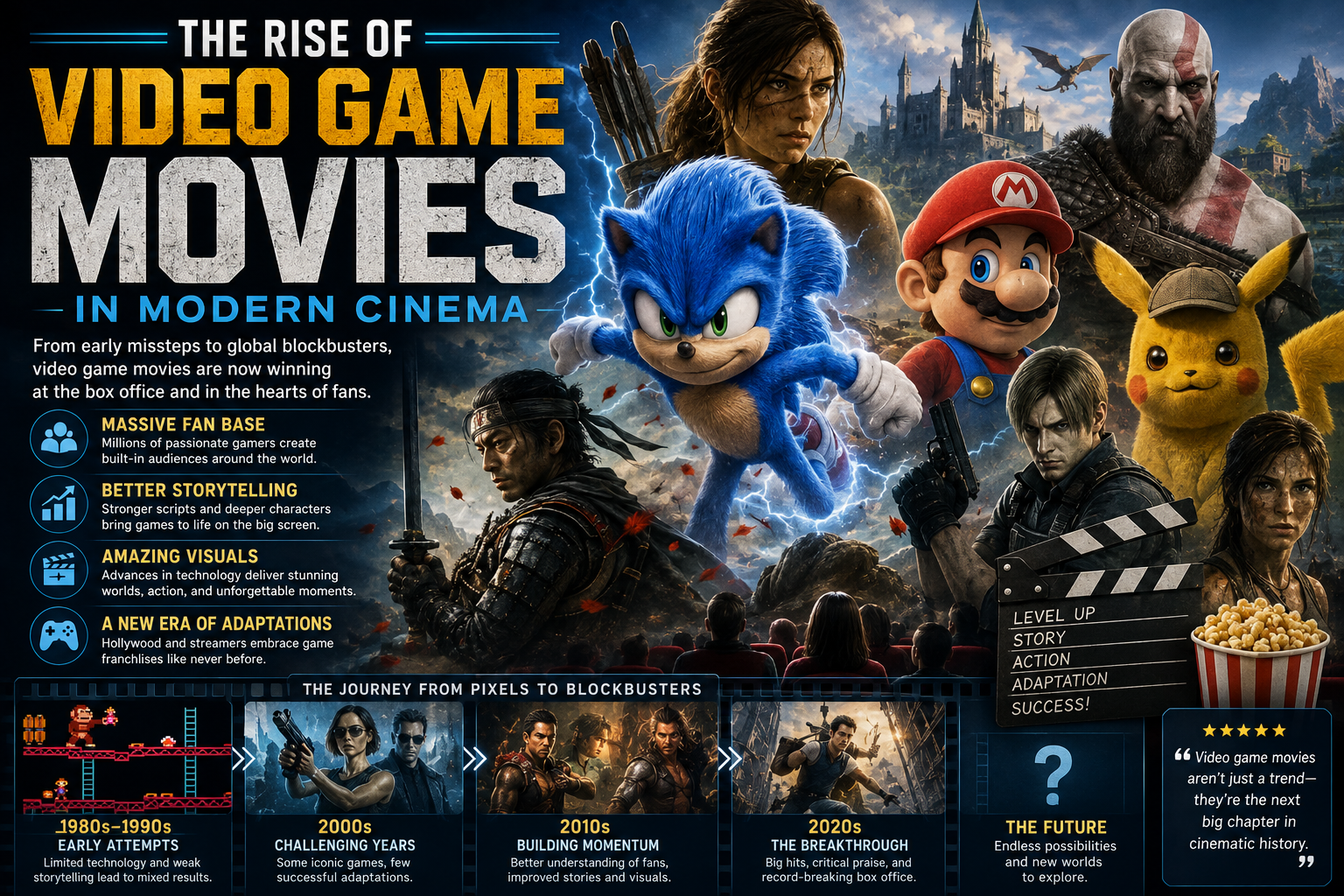
The Rise of Video Game Movies in Modern Cinema
The Rise of Video Game Movies in Modern Cinema – For decades, video game movies were considered one of Hollywood’s most challenging genres. While video games generated billions of dollars and attracted millions of passionate fans worldwide, their film adaptations often struggled to achieve critical or commercial success. Early attempts frequently failed to capture the essence of the games they were based on, leaving both gamers and moviegoers disappointed.
Today, the situation looks very different. Video game movies have become one of the fastest-growing trends in modern cinema. Major adaptations are breaking box office records, streaming platforms are investing heavily in gaming franchises, and audiences are embracing stories inspired by some of the world’s most beloved games.
The rise of video game movies reflects not only the growing influence of gaming culture but also Hollywood’s evolving understanding of how to adapt interactive experiences into compelling cinematic stories.
From Niche Adaptations to Global Blockbusters
The relationship between video games and movies dates back several decades. As video games became more popular during the 1980s and 1990s, studios began exploring opportunities to adapt popular titles for the big screen.
However, many early adaptations struggled.
Filmmakers often focused on replicating characters and settings while overlooking the gameplay experiences and emotional connections that made the games successful in the first place. Technical limitations, weak scripts, and limited understanding of gaming culture frequently resulted in movies that failed to satisfy audiences.
As a result, video game adaptations developed a reputation for being risky projects.
Despite these challenges, Hollywood never lost interest in gaming franchises. Studios recognized the enormous potential of intellectual properties that already had millions of dedicated fans.
The Gaming Industry Became Too Big to Ignore
One of the key reasons behind the rise of video game movies is the explosive growth of the gaming industry itself.
Video games have evolved into one of the largest entertainment sectors in the world. Popular franchises generate billions of dollars in revenue and often reach audiences larger than those of major film franchises.
Gaming is no longer viewed as a niche hobby. Players span multiple generations, cultures, and demographics. Mobile gaming, console gaming, PC gaming, and cloud gaming have expanded the industry’s reach to an unprecedented level.
For Hollywood, adapting successful games offers access to enormous built-in audiences. When a franchise already has millions of loyal fans, studios begin with a level of brand recognition that many original films can only dream of achieving.
This commercial potential has encouraged increased investment in video game adaptations.
Learning From Past Mistakes
A major turning point occurred when filmmakers started treating video game adaptations with greater respect.
Rather than simply using game titles as marketing tools, studios began focusing on understanding why audiences loved the source material. Writers and directors spent more time studying game worlds, characters, themes, and fan expectations.
This shift led to adaptations that felt more authentic.
Instead of forcing games into traditional movie formulas, creators started embracing the unique identities of gaming franchises. They recognized that successful adaptations needed to preserve the spirit of the original experience while also functioning as standalone films.
This approach helped rebuild trust between audiences and studios.
Stronger Storytelling Made the Difference
Modern video game movies benefit from significant improvements in storytelling.
Many contemporary games already feature cinematic narratives, complex characters, and emotionally engaging plots. As gaming technology advanced, developers began creating experiences that rivaled Hollywood productions in terms of storytelling quality.
This evolution provided filmmakers with richer source material.
Rather than adapting simple gameplay concepts, studios could now draw inspiration from expansive fictional worlds, detailed lore, and memorable character arcs. The result has been a new generation of adaptations that feel more sophisticated and emotionally compelling.
Audiences are increasingly discovering that video game movies can offer meaningful stories rather than simply relying on action sequences and visual spectacle.
Nostalgia Is a Powerful Force
Nostalgia has become one of the most influential factors in modern entertainment.
Many adults who grew up playing video games are now among the primary moviegoing audiences. Seeing beloved gaming characters and worlds brought to life on the big screen creates a strong emotional connection.
Classic franchises often benefit from decades of fan loyalty.
Viewers enjoy revisiting familiar worlds that shaped their childhoods, while younger audiences experience these iconic franchises for the first time. This combination creates broad appeal across multiple generations.
When handled effectively, nostalgia can transform a movie from a simple adaptation into a cultural event.
Advances in Visual Effects
Technology has also played a major role in the success of modern video game movies.
Many gaming worlds contain fantastical environments, creatures, and action sequences that would have been difficult or impossible to create convincingly in previous decades. Advances in computer-generated imagery (CGI), motion capture, virtual production, and visual effects have dramatically expanded what filmmakers can achieve.
Today’s studios can recreate game worlds with remarkable accuracy.
From sprawling fantasy kingdoms and futuristic cities to realistic digital creatures and epic battles, modern technology allows filmmakers to deliver experiences that closely resemble the visual excitement of contemporary video games.
This authenticity helps fans feel that the worlds they love have been faithfully translated to cinema.
Expanding Beyond Theaters
The rise of streaming platforms has further accelerated the growth of video game adaptations.
Streaming services are constantly searching for recognizable intellectual properties capable of attracting subscribers. Video game franchises offer exactly that.
Unlike traditional theatrical releases, streaming platforms can explore longer formats that allow for deeper storytelling. Complex game narratives often benefit from episodic structures that provide more time for character development and world-building.
This flexibility has encouraged studios and streaming companies to invest heavily in gaming-related content.
As a result, audiences now enjoy a wider variety of adaptations than ever before.
The Importance of Fan Communities
Video game communities have become powerful forces in modern entertainment.
Social media platforms, streaming sites, online forums, and gaming content creators allow fans to discuss, analyze, and promote adaptations on a global scale. Enthusiastic communities can generate significant excitement long before a movie’s release.
Word-of-mouth marketing has become increasingly important.
Positive reactions from dedicated fans often influence broader audiences. Conversely, negative responses can quickly spread online.
Studios have learned that engaging with gaming communities and respecting fan expectations can significantly improve an adaptation’s chances of success.
The relationship between creators and audiences has become more interactive than ever before.
Diverse Genres Expand Opportunities
Another reason for the rise of video game movies is the incredible diversity of gaming franchises.
Video games are no longer limited to action and adventure. Modern gaming includes science fiction, fantasy, horror, mystery, survival, role-playing, sports, strategy, and countless other genres.
This diversity provides filmmakers with a vast range of storytelling opportunities.
A horror game adaptation can deliver psychological tension and suspense. A fantasy game can create epic world-building. A science-fiction game can explore futuristic ideas and technological themes.
Because gaming encompasses so many genres, video game movies can appeal to a wide variety of audiences.
Challenges Still Remain
Despite recent successes, adapting video games remains a complex task.
One major challenge involves balancing fan expectations with the needs of general audiences. Hardcore gamers often want faithfulness to the source material, while casual viewers may require additional context and narrative structure.
Filmmakers must also address the fundamental difference between gaming and cinema.
Video games are interactive experiences that allow players to influence events. Movies are passive experiences where audiences observe predetermined stories. Translating player agency into cinematic storytelling remains one of the industry’s greatest challenges.
Successful adaptations find creative ways to preserve the emotional engagement of gaming while embracing the strengths of filmmaking.
The Future of Video Game Movies
The future appears exceptionally bright for video game adaptations.
As gaming continues to grow globally, more studios are investing in gaming intellectual properties. Advances in visual effects, artificial intelligence, virtual production, and storytelling techniques will further improve adaptation quality.
Emerging technologies may eventually blur the line between games and films even more. Interactive storytelling experiences, immersive virtual worlds, and AI-driven entertainment could create entirely new forms of media that combine elements of both industries.
The growing collaboration between game developers and filmmakers suggests that future adaptations will become increasingly sophisticated and ambitious.
Conclusion
The rise of video game movies in modern cinema represents one of the most significant entertainment trends of the twenty-first century. What was once viewed as a risky and unreliable genre has evolved into a major force within Hollywood and global filmmaking.
This transformation has been driven by the growth of the gaming industry, improved storytelling, technological advancements, strong fan communities, and a greater understanding of what makes video games meaningful to players.
As studios continue to invest in gaming franchises and audiences embrace these adaptations, video game movies are likely to remain a dominant part of popular culture for years to come. The connection between gaming and cinema has never been stronger, and the future promises even more exciting possibilities as these two powerful forms of entertainment continue to evolve together.
